Internal Concept
Stratum
A web-based modulation instrument that replaces patch-cable thinking with a spatial model anyone can read at a glance.
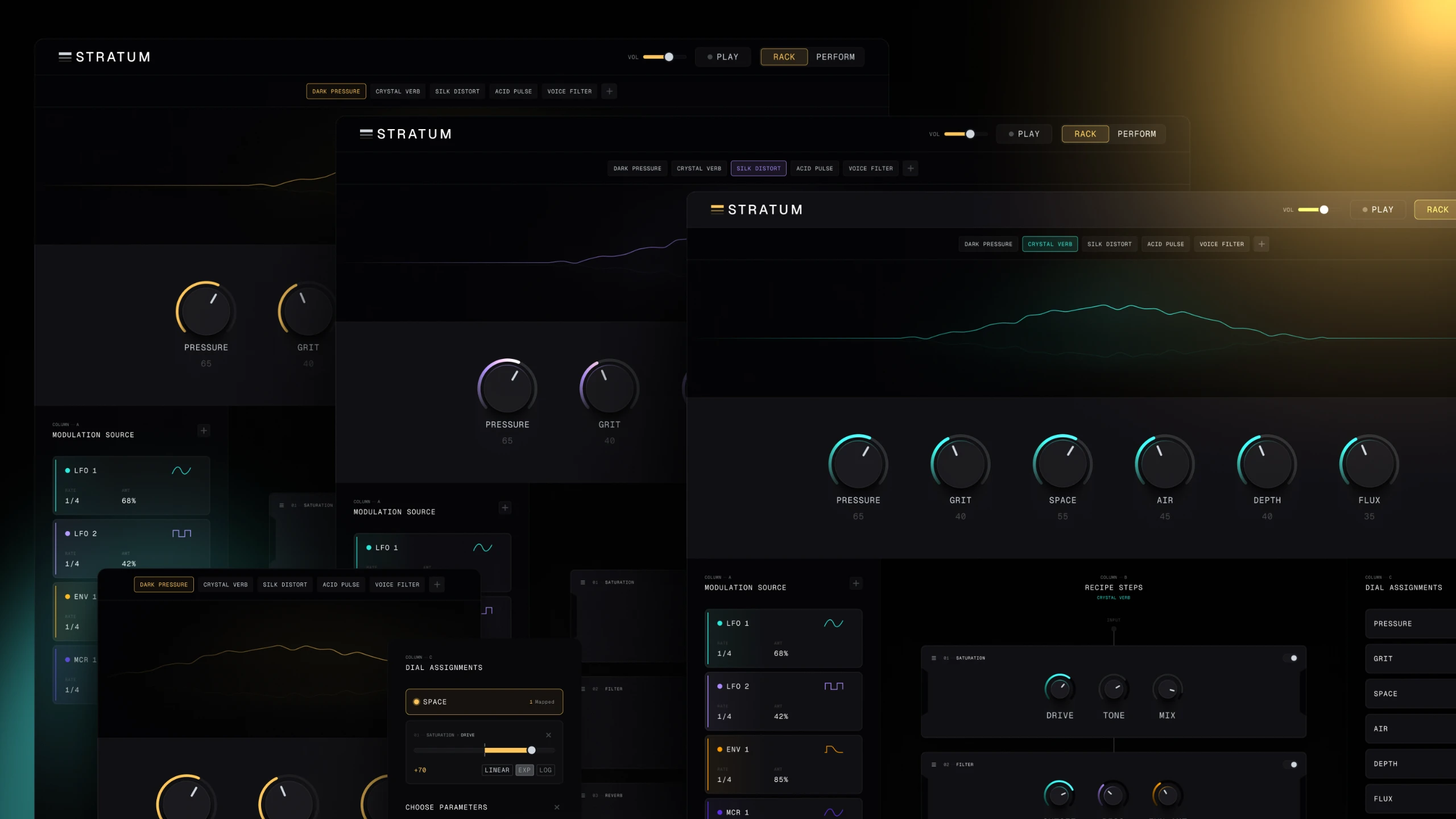
Project overview
Client
Internal Research
Industry
Audio Software
Role
Product Design + Build
Duration
2 Weeks
Stratum started with a question that's bothered me for years: why does modulation still feel like plumbing?
Every serious DAW and synth offers deep modulation routing, but using it means drawing virtual cables, digging through assignment menus, and holding a mental map of connections the interface never shows you all at once.
The goal was to design a modulation instrument that felt like an instrument something a producer could pick up and play without a manual, but that rewarded depth the more time they spent inside it. Built on the Web Audio API, it runs entirely in the browser: no install, no DAW, no barrier between curiosity and sound.
Challenge
Modulation routing is a genuinely hard interface problem because the underlying structure is a graph anything can connect to anything. Most tools expose that graph literally, and the result is powerful but illegible.
Design Principles
Space carries meaning
Audio flows down the centre. Modulation sources live on the left. Macro controls sit on the right. Once you understand the three-column structure, you understand the whole instrument position does the explaining so the interface doesn't have to.
Mapping should be visible, not remembered
Select a source, touch a knob, and the mapping ring glows in the source's colour. Every relationship in the instrument is readable at a glance, permanently no inspector panels, no hover states hiding the truth.
The player builds the instrument
The Shell Dials are a front panel you assign yourself. In Perform mode they fill the screen: the instrument you designed becomes the instrument you play.
Key Decisions
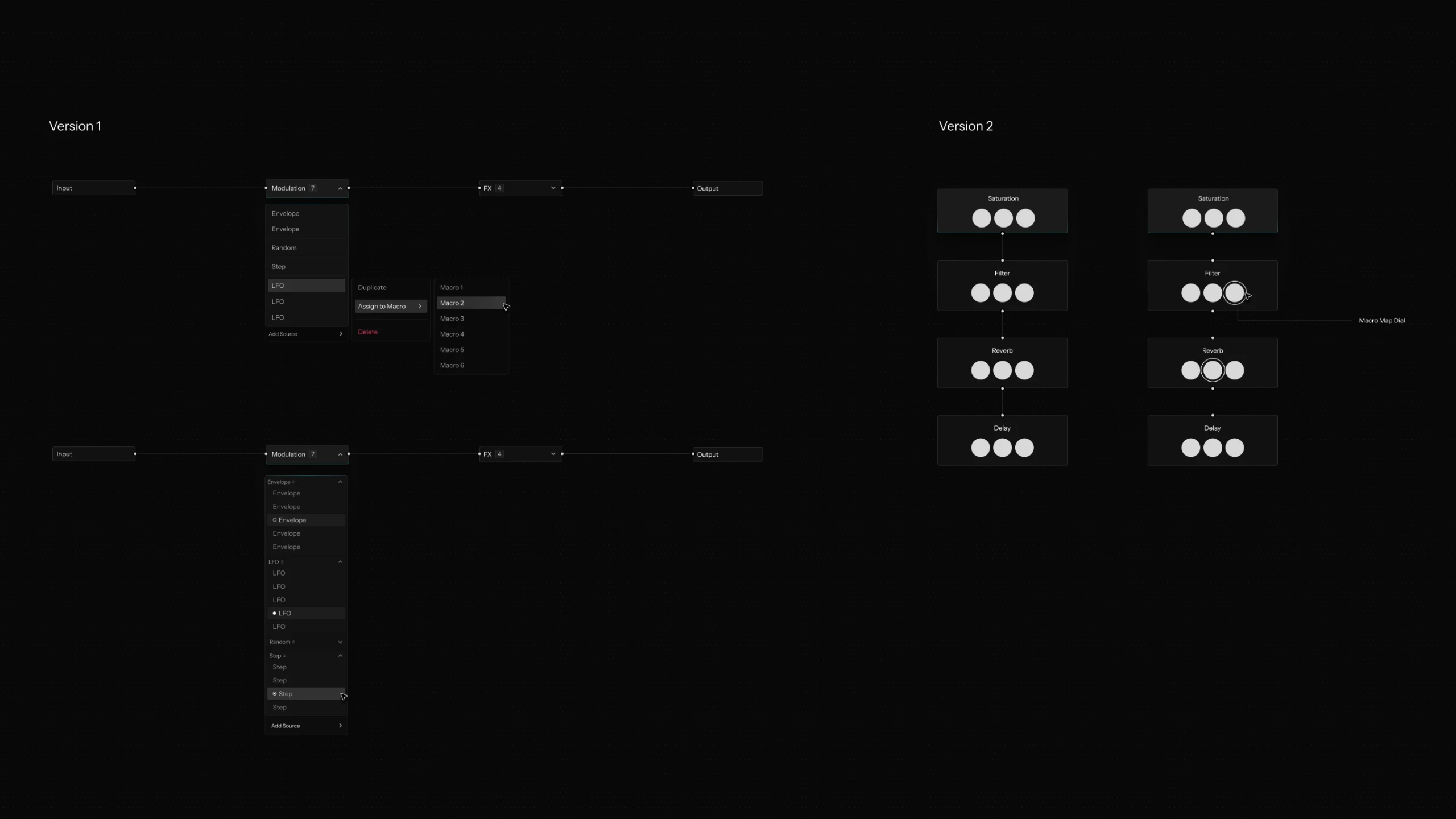
Killing the node canvas
The node-based prototype was technically capable and practically unusable. Replacing free-form patching with the fixed three-column Glass Rack traded infinite topology for instant legibility and lost almost nothing producers actually do. The constraint became the interface.
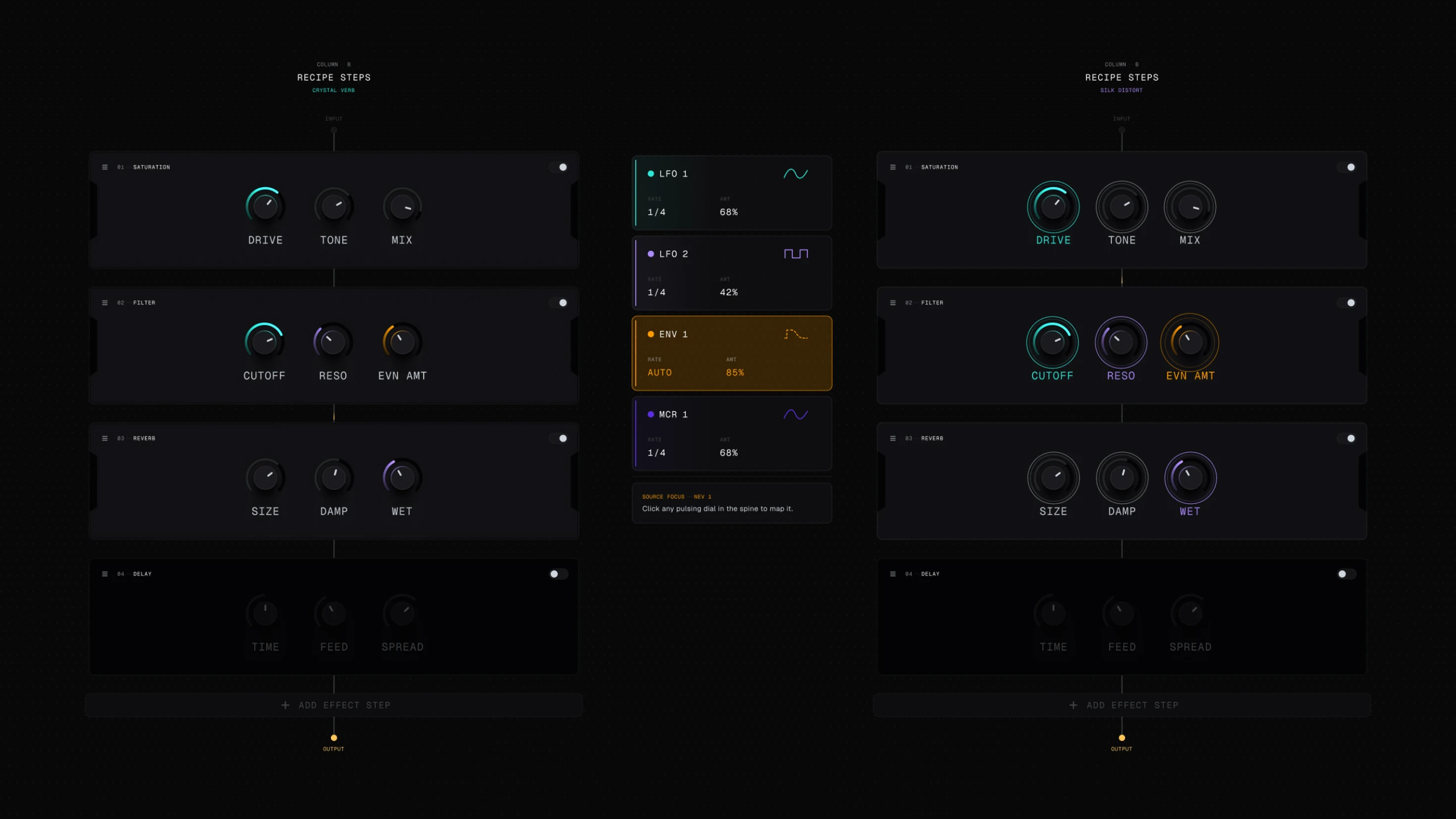
Colour as the routing language
With no cables to follow, colour carries the connection. Each modulation source owns a colour, and every dial it touches wears that colour on its mapping ring. Colour mapping to recipes took several rounds to get right enough contrast to read instantly, enough restraint to avoid a fairground.
Touch to map
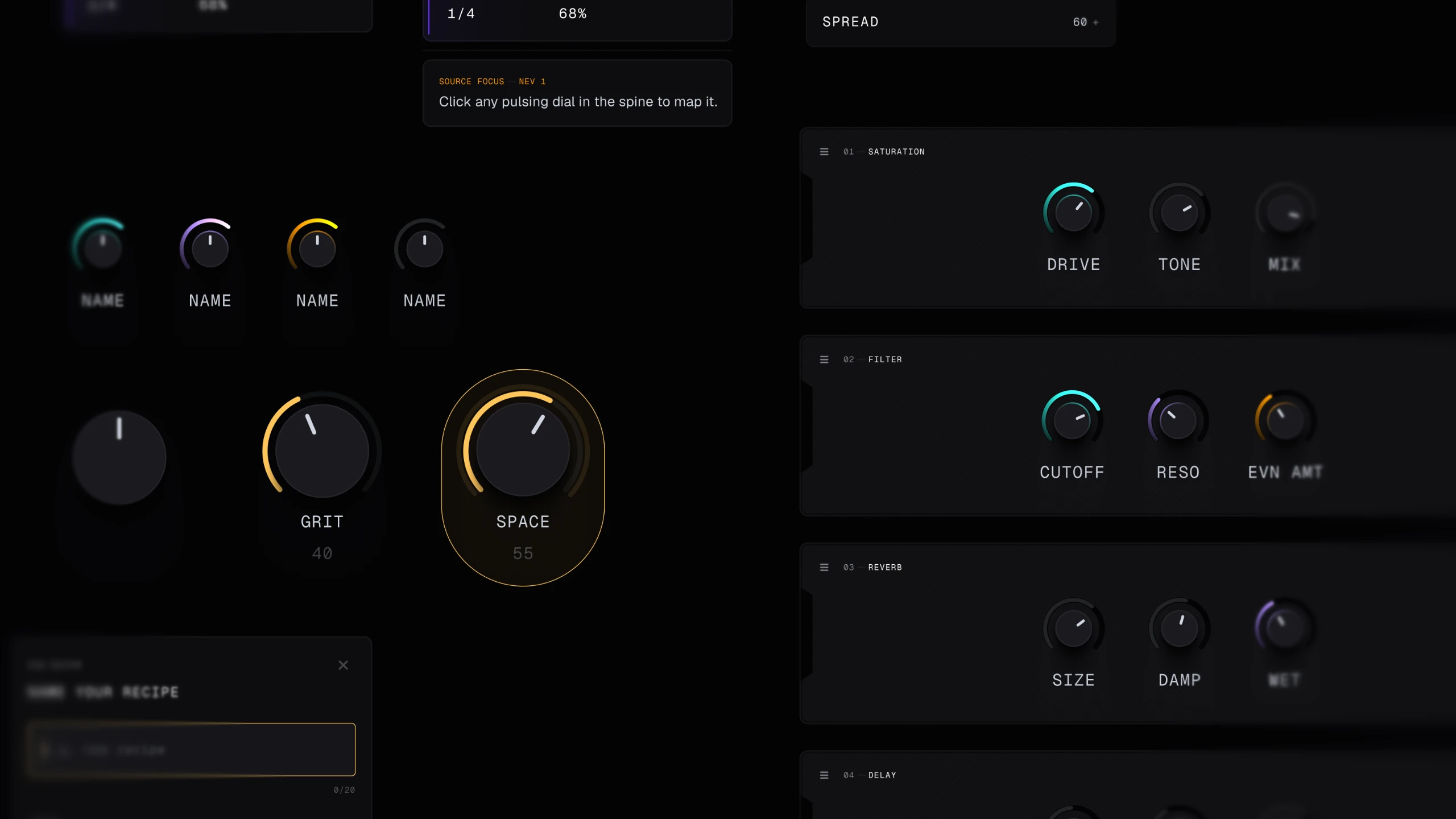
Conventional assignment flows route through menus and drop-downs. In Stratum you select a source and touch a destination. The gesture is the routing. This single interaction shaped everything else in the instrument.

Perform mode as a destination, not a toggle
Once a rack is built, the Shell Dials expand to fill the screen and the plumbing disappears entirely. Building and playing are treated as two different mindsets deserving two different interfaces.

Scaling the system
Legibility under motion
Every dial, ring and meter in Stratum animates constantly, so the system was built around staying readable while moving. Solving audio clipping in the engine and refining dial behaviour went hand in hand the visual feedback had to be honest about what the signal was actually doing, not decorative.
Outcome
Stratum shipped as a live beta web instrument, a full modulation rack, per-recipe state, file audio input, and a dedicated performance mode, running entirely in the browser.
What Shipped
Complete instrument UI: Glass Rack, Shell Dials, Perform mode
Touch-to-map interaction model
Recipe system with per-recipe state
Web Audio API signal chain
Impact
Concept to live beta in two weeks
Visitors from twelve countries within hours of launch
Average sessions approaching five minutes — people playing, not browsing
A growing waitlist ahead of the DAW plugin version
Reflection