Client Project
AgentOps
Redesigning the observability platform AI agent developers rely on from data-dense waterfall traces to a full UI language and two websites.

Project overview
Client
AgentOps
Industry
SaaS Platform
Role
Product Design & Website Design
Duration
2 Week Sprint
AgentOps is the leading observability platform for AI agents the tool engineers use to trace, debug and deploy agents built on OpenAI, CrewAI, Autogen and 400+ frameworks. Backed by a $2.6M raise and used by engineers at some of the largest companies in the world, the product had serious traction and a serious problem: it looked like it had been built by the people who built it.
Working directly with founder Alex across a two-week sprint, the engagement covered the full surface, the product's UI language rebuilt from the ground up, onboarding redesigned, and both websites (agentops.ai and agen.cy) brought into the same visual world.
Challenge
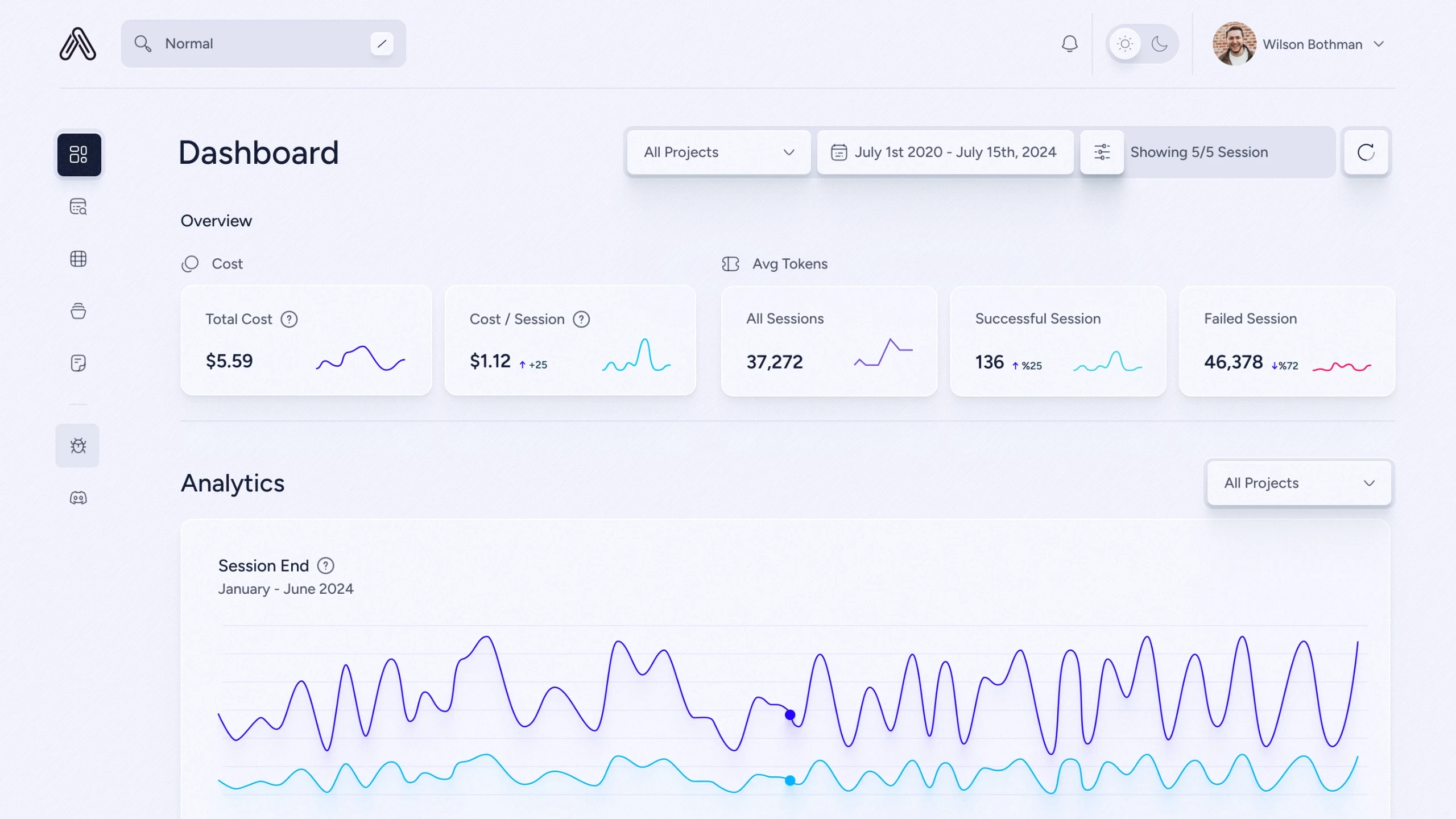
The heart of AgentOps is the waterfall trace: a timeline of every LLM call, tool use and agent interaction in a session. The data was all there, the visualisation was engineering-led, built to confirm the system worked rather than to help a human understand what an agent actually did.
That's the trap of observability tools: instrumentation is not comprehension. An engineer debugging a misbehaving agent at 2am doesn't need more data on screen, they need the screen to already be telling them where to look. The challenge was taking genuinely dense, hierarchical, time-based data and making it readable at a glance without stripping out the depth that makes it useful.
Design Principles
Charts answer questions, not describe systems
Every visualisation was rebuilt around the question an engineer brings to it, what ran, what failed, what cost me money, rather than around the shape of the underlying data.
Density is fine, noise is not
Agent traces are legitimately complex, and hiding that would break trust. The redesign kept the density and removed the competition, one visual weight for structure, one for status, colour reserved for meaning.
Onboarding is the first debug session
A developer's first minutes in AgentOps were treated as a trace of their own: a clear path from install to first insight, with nothing between them and seeing their agent run.
Key Decisions
Rebuilding the waterfall for human reading
The trace view was restructured around scanning order, hierarchy carried by indentation and weight rather than borders and boxes, timing readable as shape, failures impossible to miss. Same data, redesigned to be read rather than decoded.

Working sessions with the founder, not handoffs
Data this specialised can't be designed at arm's length. The sprint ran as close working sessions with Alex, shaping visualisations against real agent runs, testing whether each iteration answered the actual questions engineers ask.
A UI language, not a reskin
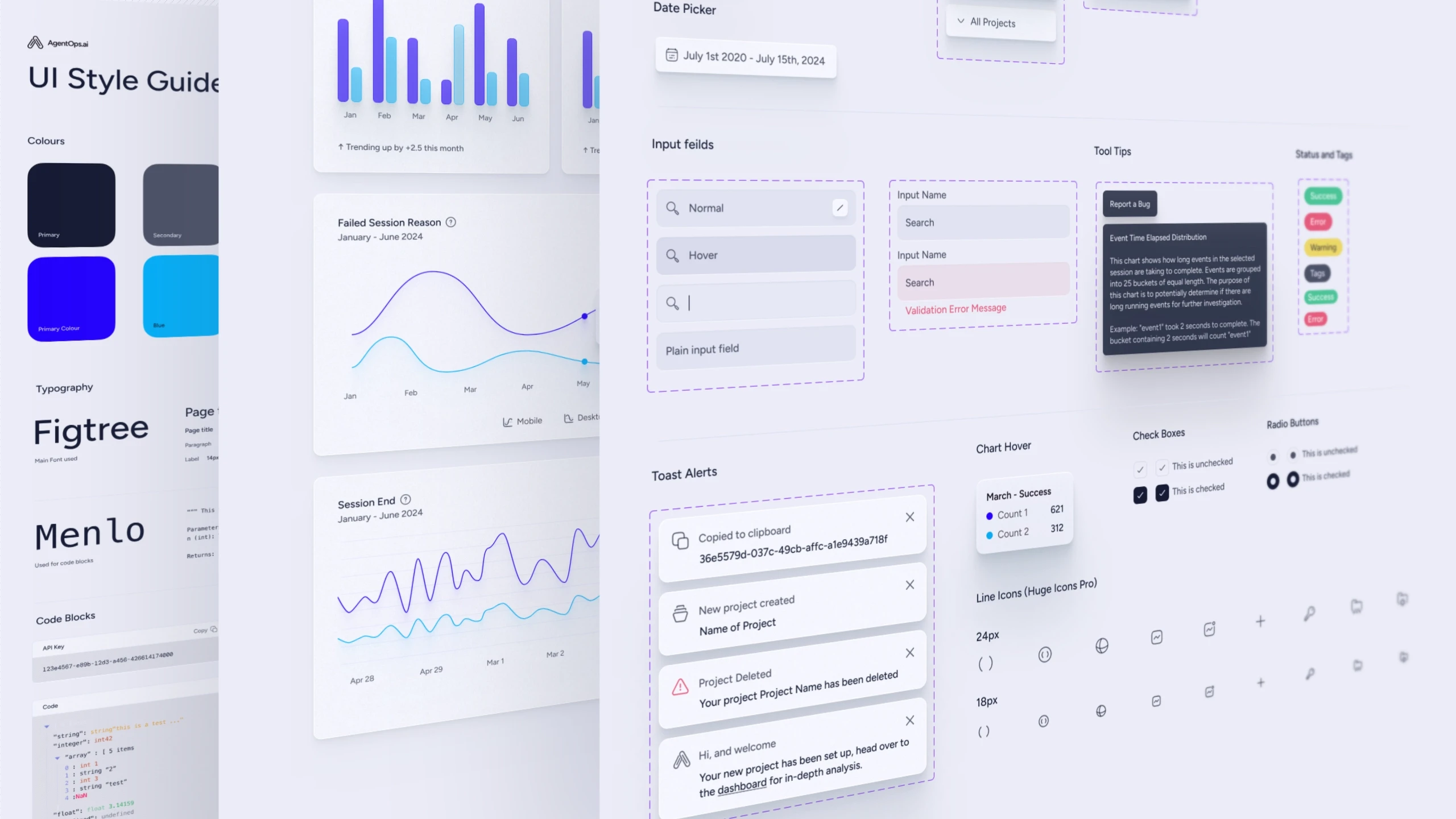
Rather than restyling screens one by one, the sprint established a system type scale, colour logic, component behaviour, data-vis rules that the engineering team could extend without design present.

Two sites, one identity
agentops.ai and agen.cy were designed as siblings: the developer platform and the company holding it, visually unmistakable as the same team.

Scaling the system
Rules for dense data
The system's core job is discipline under density a restrained palette where colour only ever signals state, typography that holds hierarchy in tightly packed traces, and components built to survive real-world data: hundred-event sessions, deeply nested calls, failures mid-stream. The language flexes from marketing page to waterfall chart without breaking.
Outcome
A full product redesign, new UI language and two websites, delivered in a two-week sprint working directly with the founding team.
What Shipped
Redesigned waterfall trace and session views
Complete UI language and component system
Rebuilt onboarding flow
agentops.ai marketing site
agen.cy company site
Impact
Platform serving thousands of engineers, 4,000+ GitHub stars
Showcased at exhibition to significant praise
Design system extended by the engineering team beyond the sprint
Reflection